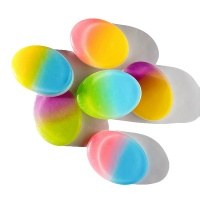
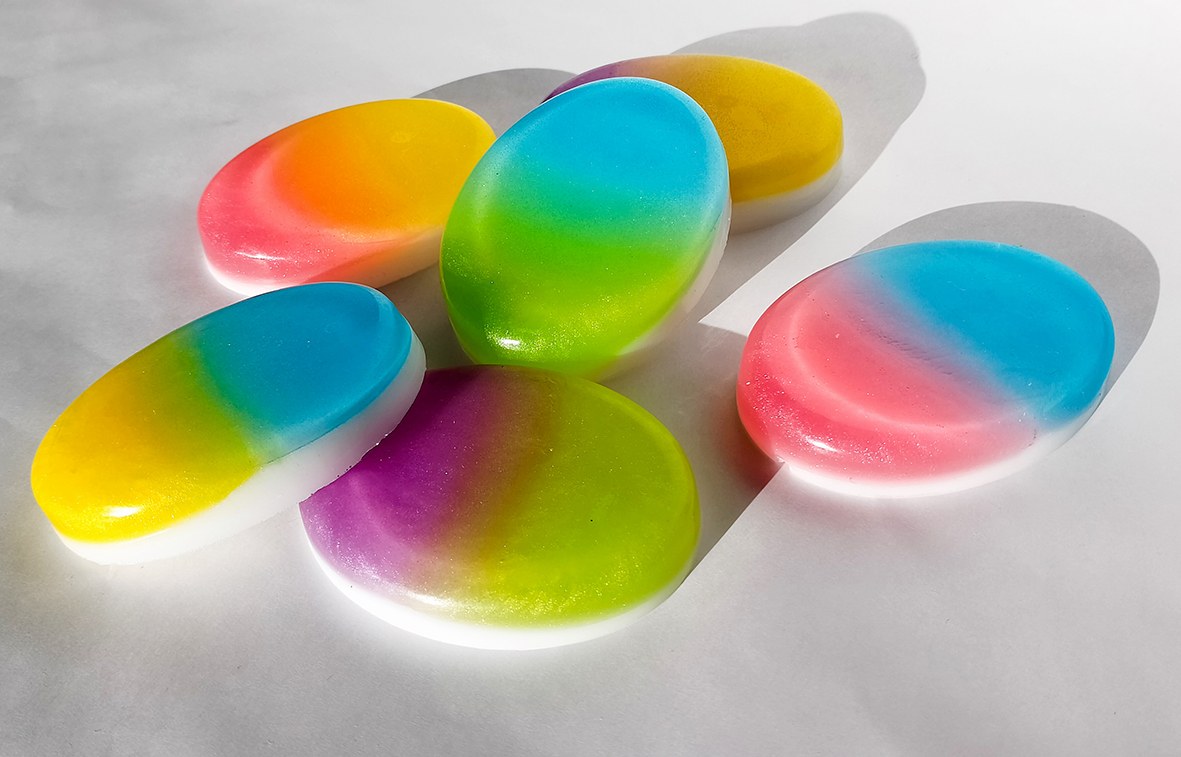
Ombré soap — aesthetic little soaps with a natural composition? Now we’re talking. Do you also want to make Instagram-perfect ombré soaps? We bring you a simple guide on how to achieve the desired ombré effect when using melt-and-pour soap bases. Try making ombré soaps for yourself or as a gift and let yourself be surprised by the beautiful result.
About this recipe
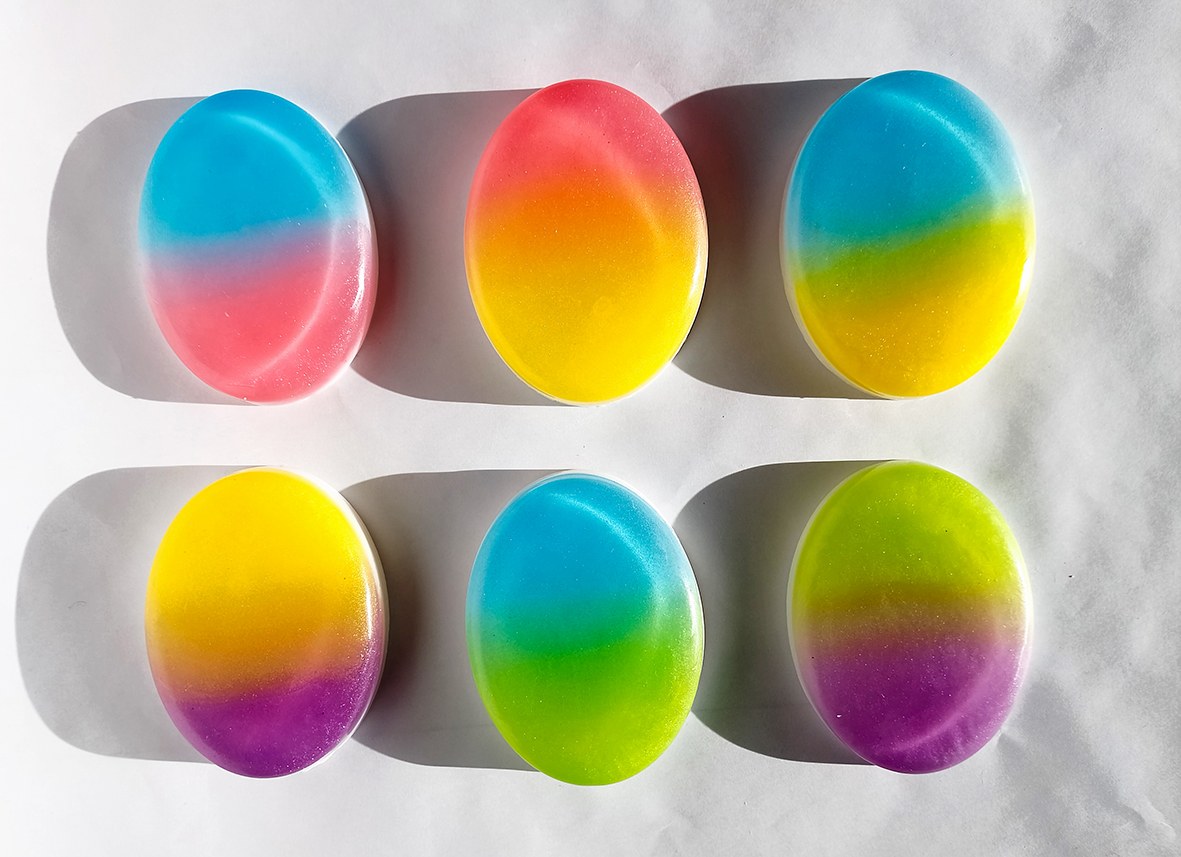
We would like to thank Ivana Jačalová for this great guide to making ombré soaps. This is a soap made from soap bases — to make it you need a combination of transparent layers that will be coloured with mica powder, and a white layer that will help each colour stand out better. You can choose the mica powders according to your own imagination; try different combinations of colours and fragrances to prepare ombré soap exactly to your taste.
The amount of soap base in the recipe is calculated for one oval soap bar made in the specified mold.
Main benefits
- Ombré effect from a tilted mold
The coloured layers are poured into a mold propped up with a book (approx. 1 cm thick) — once from one side, then from the opposite side, which is how the colour gradient is created.
- The white layer makes the colours stand out
The transparent layers are finally backed with white base, which allows the colours to be highlighted.
- Colours to suit your own imagination
The range of mica powders is really wide and the dosage is flexible — you can keep adding powder until you reach the shade you want.
- Non-sweating soaps
ZENIOSOAPBASE Clear provides non-sweating soaps, i.e. your soap will not become covered with dew-like droplets after standing for a longer time, and it also dries more slowly.
- Quickly finished
ZENIOSOAPBASE Pro-W sets faster than bases intended for more demanding design creations, so your soap is ready sooner.
Product properties
Key ingredients in the recipe
Do you want to find out more about the individual ingredients used for making ombré soap? You are in the right place. We will introduce the individual ingredients that were selected for the preparation of the ombré soap.
ZENIOSOAPBASE Clear
For making ombré soap we chose a combination of transparent soap base to create the desired colour effect and a white base which allows the colours to be highlighted.
ZENIOSOAPBASE Clear is a universal transparent soap base that you can use for various types of melt-and-pour soap projects. The advantage is that it provides non-sweating soaps, i.e. your soap will not become covered with dew-like droplets after standing for a longer time. Another advantage is that the soap dries more slowly; however, if you want to store the finished ombré soaps for a longer period, wrap them in cellophane, which will prevent the soap from drying out or warping as a result of water loss.
ZENIOSOAPBASE Pro-W
ZENIOSOAPBASE Pro-W is a great soap base for larger projects, because in addition to protection against sweating it sets faster than types of soap bases intended for more demanding design creations. Thanks to this, you can have your soap ready more quickly.
The soap bases mentioned can be replaced with other soap bases, but always choose combinations of transparent base for the coloured layers and white base for finishing the soap.
Mica powders
For colouring the individual layers of the soap, mica powders were chosen. The guide lists the exact shades that we used for the individual colour combinations. These are the yellow shade Bonny buttercup, the pink Frosty rose petal, the blue Deep ocean blue, the purple Soft amethyst and the green Lime.
The range of mica powders is really wide, so do not hesitate to use your imagination and combine your favourite shades. The dosage is also flexible in this case; you can add more mica powder after the soap has melted, until you reach the desired shade.
An alternative to mica powders are colourants for soap bases, for example ZENICOLOR, which combine well with the soap bases of the given brand. These colourants can also be used in other soap bases; however, you may not obtain exactly the same shades as indicated by the manufacturer.
Fragrance oil
For scenting the soap, a bamboo and green tea fragrance oil was chosen, which offers a fresh, clean and slightly floral fragrance with notes of eucalyptus, bergamot and white flowers. However, you have a truly wide palette of different fragrance oils at your disposal, which you can freely combine and create ombré soap exactly according to your ideas.
For example, you can choose a different fragrance oil for each layer of soap or leave the soap unfragranced.
An alternative to fragrance oils are essential oils, but some dark-coloured essential oils can affect the final colour of the soap.
IPA — isopropyl alcohol
Bubble remover or isopropyl alcohol is a substance that fulfils two functions when making soaps from soap bases. The first is that it helps remove bubbles and foam from the surface of freshly poured soap. Therefore, it is necessary to spray each layer immediately after pouring, while it is still liquid; otherwise the bubbles will not be removed.
Afterwards, each layer is sprayed once it has solidified, just before pouring the next layer. It is IPA that ensures better adhesion of the individual layers to each other.
Other ingredients
Oval silicone mold — the weights given are related to the mold we used. For production, molds with a smooth bottom are suitable: if the bottom contains a relief or other protrusions, it may visually disturb the ombré effect of the soap.
Recipe (in grams)
The specified amounts of soap base, colourants and fragrance required are given in grams and not in percentages, precisely so that you maintain the correct ratio of ingredients to create the desired appearance of the soap. The weights are related to the mold we used — if you change the mold, you will need different amounts of soap base, but you can keep the ratios as long as you do not want to change the thickness of the individual layers. When making a larger quantity of soap, multiply the weight by the number of individual soap bars you want to prepare.
| Name of ingredient | Amount in (g) |
|---|---|
| Soap bases | |
| ZENIOSOAPBASE Clear | 45 g |
| ZENIOSOAPBASE Pro-W | 20 g |
| Colourants | |
| Mica powder Bonny buttercup | 0.1 g |
| Mica powder Frosty Rose Petal | 0.1 g |
| Mica powder Deep ocean blue | 0.1 g |
| Mica powder Lime | 0.1 g |
| Fragrance | |
| Fragrance oil, Bamboo & Green Tea | 0.6 g |
| Equipment | |
| IPA isopropyl alcohol | as needed |
| Oval silicone mold | — |
Method
- Propping up the mold approx. 1 cm
Prop up the shorter edge of the mold with a book (approx. 1 cm thick) or another object.
- First coloured layer 22.5 g
Into a heat-resistant container weigh out 22.5 g of transparent soap base. Add any mica powder; an approximate amount is enough, you do not have to stick to the specified amounts of colourants.
- Melting and pouring approx. 30 s
Heat the mixture for approx. 30 seconds in the microwave until melted (the soap must not boil), add 0.2 g of fragrance oil, stir and pour into the tilted mold (propped up with the book). The soap should cover ¾ of the bottom of the mold. Spray with IPA immediately (removal of bubbles).
- Second coloured layer 22.5 g
After the layer has solidified, prop up the opposite edge of the mold, into a heat-resistant container weigh out 22.5 g of transparent base and add a second mica powder of your choice.
- Melting the second layer approx. 30 s
Let the soap base melt in the microwave (approx. 30 seconds), add 0.2 g of fragrance oil and mix.
- Pouring the second layer
Pour the melted soap base into the mold that you have sprayed with IPA beforehand; the soap should cover ¾ of the previous solidified layer. Spray immediately with IPA.
- Levelling the mold
After solidification, remove the book or other object you used to prop up the mold and place the mold on a flat surface.
- White layer approx. 30 s
Into a heat-resistant container weigh out the white base, heat for approx. 30 seconds in the microwave until melted. Then add the fragrance oil (0.2 g) and stir.
- Pouring the white layer
Pour the base onto the previous two layers, which you sprayed with IPA beforehand, so that the white base completely covers the previous layers. Immediately after pouring the soap base, spray it with IPA.
- The finished soap
After solidification the soap is ready to use.
Tips and tricks
Below you will find tips that will help you when making ombré soap.
In addition to the microwave, the soap base can also be heated in a water bath; the whole process will take longer, but on the other hand you do not have to worry that the soap will quickly come to a boil and boil over, as can easily happen in the microwave.
If your soap solidified during the process, don’t despair, you can still melt it again, either in a water bath or in the microwave.
When making a larger quantity of soap, multiply the weight by the number of individual soap bars you want to prepare. The specified amounts apply only to the mold we have chosen. If you choose another mold, it is necessary to recalculate the amount of soap base; the coloured layers should have the same weight and there should be enough white base to cover the entire surface of the soap.
For production, molds with a smooth bottom are suitable. If the bottom contains a relief or other protrusions, it may visually disturb the ombré effect of the soap.
The consumption of soap base also depends on how much you prop up the edge of the mold. The more the mold is tilted, the more soap base you will use to cover ¾ of the bottom of the mold.
Warning
As mentioned, you can experiment with homemade formulations to achieve the desired properties. However, the final result can be influenced by many factors, such as humidity, temperature, quality of the ingredients or their storage.
Before using any ingredient to make a cosmetic product, get familiar with its properties, the recommended dosage, storage conditions and safe handling. Each ingredient can have the potential to trigger an allergic reaction in sensitive individuals, therefore before using the product we recommend finding out whether you suffer from an allergy to any of the ingredients or to the overall product, for example by means of a patch test.
If you have very sensitive or very acne-prone skin, or if you have other skin or health problems, we recommend that you consult a medical professional before applying a new product to the skin, whether it is a homemade cosmetic product, a pure ingredient or a commercially available product.
Frequently asked questions about the recipe
Practical questions about ombré soap — melting the base, choosing a mold, IPA and swapping the colourants.
Do I have to melt the soap base in the microwave?
No — in addition to the microwave, the soap base can also be heated in a water bath. The whole process will take longer, but on the other hand you do not have to worry that the soap will quickly come to a boil and boil over, as can easily happen in the microwave.
What should I do if the soap solidifies while I am working?
Don’t despair — solidified soap can be melted again, either in a water bath or in the microwave.
How do I make several soap bars at once?
When making a larger quantity of soap, multiply the weight by the number of individual soap bars you want to prepare. The specified amounts apply only to the mold we have chosen — if you choose another one, it is necessary to recalculate the amount of soap base, whereby the coloured layers should have the same weight and there should be enough white base to cover the entire surface of the soap.
Why does every layer need to be sprayed with IPA?
IPA fulfils two functions: it removes bubbles and foam from the surface of freshly poured soap (so spray immediately after pouring, while the layer is still liquid) and, once the layer has solidified, just before pouring the next one, it ensures better adhesion of the individual layers to each other.
Which mold should I choose?
For production, molds with a smooth bottom are suitable — a relief or other protrusions may visually disturb the ombré effect. The consumption of soap base also depends on how much you prop up the edge of the mold: the more the mold is tilted, the more base you will use to cover ¾ of the bottom.
Can mica powders be replaced with another colourant?
Yes, an alternative to mica powders are colourants for soap bases, for example ZENICOLOR, which combine well with the soap bases of the given brand. They can also be used in other soap bases; however, you may not obtain exactly the same shades as indicated by the manufacturer.
Conclusion
Have you ever been so happy with your creation that you just had to share it on social media right away? If you create this colourful ombré soap, be sure not to forget to show it to us. Send us photos to [email protected] or tag us on Facebook.
We would like to thank Ivana Jačalová for this great guide to making ombré soaps.
Stay creative.
Until the next soaping, friends.
You will find the soap bases, mica powders, fragrance oils and IPA from this recipe in the Handymade range.