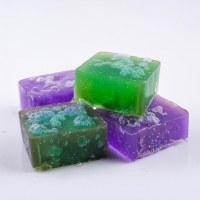
Jelly soap brings a smile to the face not only of children but also of adults — it makes a fun and at the same time useful gift for young and old alike. Maybe you have already come across interesting videos or photos of jelly soap, or maybe you are hearing about it for the very first time; either way, you too can make such a soap at home. We bring you two recipes for preparing jelly soap in the comfort of your own home.
About this recipe
This great tutorial on making jelly soap was prepared by Ivana Jakalová. In it you will find two basic recipes — the first with the powder surfactant SCS (sodium coco sulfate) and the second with liquid decyl glucoside — including a comparison of the two. For the soap to foam, it must contain a surfactant, which ensures the cleansing and foam-forming effects; the gelling component is carrageenan — a plant-based thickener that is excellent for making firm jellies and is moreover vegan.

Main benefits
- Fun and a gift
Jelly soap brings a smile to the face of children and adults alike, and you can use it as a gift.
- Vegan jelly
The gelling component is carrageenan — a plant-based thickener suited to making firm jellies.
- Two surfactant options
Choose according to the ingredients you have to hand: powder SCS, or liquid decyl glucoside if you avoid sulphates.
- Rich foam
The version with decyl glucoside provides an intense and rich foam, more pronounced than with SCS.
- Colours to match your ideas
Mica powders offer a wide palette of colours, and you choose the intensity of the colouring by how much you add.
Product properties
Key ingredients in the recipe
Below we will go through the individual ingredients and their importance for the recipe. You will also learn more about their possible substitutions, so that you can tailor the jelly soap recipe to your own needs.
Carrageenan
The thickener and gelling agent in this recipe is carrageenan. Thanks to this plant-based substance, we obtain a nicely firm jelly. Carrageenan dissolves in water after heating to about 70 °C, therefore it is necessary to heat products containing it, otherwise your soap will not set. If you want a less firm jelly, reduce the carrageenan content by about 0.5 to 1%; if you want it firmer, increase it by the same amount.
SCS — sodium coco sulfate
SCS is a surfactant that is widely used in various types of cosmetics requiring foaming and cleansing effects. It is sold in the form of white beads, so during handling it does not enter the air as intensively and does not irritate the respiratory tract as SCI does. It is a convenient form of surfactant that is easy to dose and dissolves quickly in water.
Decyl glucoside
An alternative to SCS is decyl glucoside — a liquid surfactant with a higher pH, therefore pH adjustment of the final product is necessary. It provides an intense and rich foam, more pronounced than when using SCS. It has similar properties to coco glucoside, however we did not test this variant, so we cannot guarantee that the resulting soap will set when it is used.
Glycerine
Glycerine is an important component in both recipes — an alcohol of plant origin that is widely used in cosmetics as a skin humectant. In our case it helps to speed up the dissolution of carrageenan: it provides the powdered form with a better environment for hydration than if the carrageenan were added directly to water — lumps would form. The same applies to mica powder; thanks to glycerine it disperses faster and colours the product evenly. For this reason, do not omit glycerine or substantially change its proportion in the recipe.
Other ingredients
Demineralised water is the basis for dissolving the surfactants and for forming the jelly — in combination with carrageenan it creates a firm gel. You can also replace it with floral hydrolates, which additionally give the product a delicate scent and can replace essential oils.
Mica powders are used to colour your products. They are usually combined with glycerine for even dispersion after the water is added; if they are added at the end, there is a risk that lumps will remain in the product. You choose the intensity of the colouring by how much you add.
Essential oils give the soaps a pleasant fragrance. They are released more intensively when warm — when adding them to a hot mixture you will lose part of the oil, but during showering and contact with warm water they will be released from the soap more intensively. You can also prepare an unfragranced version, or reach for fragrance oils, which offer a wider palette of scents.
Lactic acid is used for pH adjustment. It is sold already as a solution and is quite concentrated. When adjusting the pH, proceed slowly — add it drop by drop, stir, check the pH with pH strips, for example, and only then add the next amount.
IPA (isopropyl alcohol) is a universal substance for removing bubbles from soaps. The easiest way is to have IPA in a spray to hand; without it, count on bubbles on the surface of the soap.
Formulation (100 g)
The ingredient content is given in percentages by weight, so it corresponds to a batch of 100 g of finished soap. We have prepared two versions — one with SCS and one with decyl glucoside; each has its own shopping list, table and procedure.
Version 1 — jelly soap with SCS
| Phase / ingredient | Content |
|---|---|
| Phase A | |
| Demineralised water | 56.00% |
| SCS — sodium coco sulfate | 4.65% |
| Phase B | |
| Carrageenan | 2.25% |
| Mica powder Soft Amethyst | 0.50% |
| Glycerine | 36.10% |
| Phase C | |
| Lavender essential oil | 0.50% |
| IPA (isopropyl alcohol) | as needed |
| Tools | |
| Silicone mould, rectangle | — |
Version 2 — jelly soap with decyl glucoside
| Phase / ingredient | Content |
|---|---|
| Phase A | |
| Demineralised water | 71.00% |
| Glycerine | 10.00% |
| Mica powder Enchanted Forest | 0.50% |
| Carrageenan | 4.00% |
| Phase B | |
| Decyl glucoside | 14.00% |
| Phase C | |
| Lactic acid | as needed |
| IPA (isopropyl alcohol) | as needed |
| Pine essential oil | 0.50% |
| Tools | |
| Silicone mould, rectangle | — |
Method
Version with SCS
- Disinfection
Thoroughly disinfect all the tools, vessels and containers you will be using, for example with ethanol.
- Carrageenan paste Phase B
Into a vessel weigh out the carrageenan, glycerine and mica powder, mix thoroughly to a thick paste and set aside.
- Water bath Phase A
Into a second heat-resistant vessel weigh out the water, place it in a water bath and start heating.
- Dissolving the SCS Phase A + B70 – 80 °C
As soon as the water reaches a gentle boil, disperse the SCS powder in it. Once it has dissolved, add the mixture of glycerine, carrageenan and mica powder you prepared in advance and stir thoroughly.
- Dissolving the carrageenan 70 – 80 °C10 min
Maintain for roughly 10 minutes at 70 – 80 °C, so that the carrageenan has enough time to dissolve. Then test a small amount of the mixture on a cold plate — if it has set, you can remove it from the water bath.
- Essential oil Phase C
The mixture sets quite quickly, so add the essential oil while it is still at a higher temperature — if you waited for it to cool down, the mixture would set and the oil could not be added.
- Pouring into the mould Phase C
Immediately after adding the essential oil, pour into the silicone mould of your choice and spray the filled mould with IPA — in this way you remove the bubbles.
- Setting
Once it has set, the soap is ready to use.
Version with decyl glucoside
- Disinfection
Again, disinfect all the tools, vessels and containers, for example with ethanol.
- Base mixture Phase A
Into a heat-resistant vessel weigh out the glycerine, mica powder and carrageenan, mix to a thick paste and add the demineralised water.
- Water bath 70 °C
Place the mixture in a water bath and heat at 70 °C until the carrageenan dissolves. Remove it from the bath only once the carrageenan is gelling — you test this by applying a small amount to a small plate; if the mixture sets, it has been heated sufficiently.
- Decyl glucoside Phase B
After removing from the water bath, immediately add the decyl glucoside and stir thoroughly.
- pH adjustment Phase C
Check the pH with pH strips, for example, and add the lactic acid drop by drop (the stated amount is only indicative), so that you bring the pH below 7, ideally to 4.5 – 5.5.
- Essential oil Phase C
Add the essential oil, mix well and pour immediately into the prepared mould.
- Removing the bubbles
Spray the filled mould with IPA to remove the bubbles.
- Setting
Once it has set, the soap is finished and ready to use.
Tips and tricks
After removing from the water bath, the mixture sets very quickly, so do not hesitate with adding the essential oil. Due to the higher temperature, part of the oil evaporates and some thermal degradation may also occur, however when the temperature drops below 40 °C the mixture is too firm to incorporate other substances.
For this reason, no preservative was used in the product either, even though jelly soap contains a relatively high amount of surfactants and carrageenan. At the higher temperature, when it is still possible to add substances, the preservative would degrade and would not provide protection. This is also why it is good to use the product up as quickly as possible.
After use it is good to store the soap away from water (watch out for residual water in the soap dish). Long-term storage is not recommended — the soap will start to dry out when it is not used. Therefore prepare smaller batches, so that you always have a fresh product to hand.
The same advice applies to the version with decyl glucoside: add the decyl glucoside and the lactic acid immediately after removing from the water bath, otherwise the mixture will set. Although a higher temperature causes inaccuracies in determining the pH, this should not significantly affect the final pH — the goal is to move from an alkaline pH (8 and above) to a neutral one (pH 7), or slightly acidic (down to pH 4.5).
Comparison of the two soaps
Already at first sight the soaps differ partially in the working procedure — in the first case we use a powder surfactant and in the second a liquid one. The surfactants also have different pH values: decyl glucoside is strongly alkaline, therefore pH adjustment is necessary. You can also carry out pH adjustment with the SCS soap, but since SCS has a lower pH, it is not as necessary.
During use, the soap with decyl glucoside provided a slightly larger foam; however, if it set too much, it can withstand only one more heating for additional dissolution. In other respects it was comparable to the jelly soap with SCS.
The main criterion for you will therefore probably be the availability of ingredients — if you have SCS to hand, choose the first recipe; if you prefer working with glucosides, you will reach for the version with decyl glucoside.

Warning
You can experiment with home recipes to achieve the properties you want, however the final result can be influenced by many factors — humidity, temperature, the quality of the ingredients or the way they are stored.
Before using any ingredient, familiarise yourself with its properties, recommended dosage, storage conditions and safe handling. Every ingredient can potentially trigger an allergic reaction in sensitive individuals — before using the product we recommend finding out, for example with a skin test, whether you are allergic to any of the ingredients or to the overall product.
If you have very sensitive or acne-prone skin, or other skin and health problems, we recommend that you consult a medical professional before applying a new product to the skin — whether it is a home cosmetic product, a pure ingredient or a commercially available product.
Frequently asked questions about the recipe
Practical questions about jelly soap — replacing the carrageenan, preservation, storage and choosing a surfactant.
Can carrageenan be replaced with gelatine?
Yes, carrageenan can be replaced with animal gelatine, but at the same dosage you may achieve a jelly of a different firmness. Try dosages with different proportions of gelatine until you obtain the firmness you want. Carrageenan is moreover plant-based, so a soap made with it is vegan.
Why is there no preservative in the soap?
After removing from the water bath the mixture sets very quickly, and at the higher temperature, when it is still possible to add substances, the preservative would degrade and would not provide protection. Therefore use the product up as quickly as possible and prepare smaller batches.
How should jelly soap be stored?
After use, store it away from water and watch out for residual water in the soap dish. Long-term storage is not recommended — the soap will start to dry out when it is not used.
Which version should you choose — SCS or decyl glucoside?
The main criterion is the availability of ingredients. The version with decyl glucoside provides a slightly larger foam, but it requires pH adjustment with lactic acid; SCS has a lower pH and adjustment is not as necessary.
Why does the essential oil have to be added while the mixture is still hot?
The mixture sets quite quickly — when the temperature drops below 40 °C it is too firm to incorporate other substances. Part of the oil does evaporate in the heat, but during showering and contact with warm water the fragrance is released from the soap all the more intensively.
Conclusion
Jelly soap is a fun and interesting way to liven up your evening ritual or make the hygiene routine more pleasant for children. Have you ever tried something similar? We thank Ivana Jakalová for the great tutorial on making jelly soap.
If you have any questions or ideas on how to improve jelly soap further, write to us at [email protected]. Until we see each other again with another tutorial or article, have nice and creative days.
Until soaping again, friends.
You will find the carrageenan, surfactants, mica powders and essential oils from this recipe in the Handymade ingredients range.